Every firm says it is disciplined. Very few show you how. This is exactly how Jetstream decides whether a deal is worth your money, and when we walk away.
Most investors focus on the upside first. We start at the other end. Before we look at what a property could earn, we look at what could go wrong, and whether your capital survives it.
Only after a deal proves it can hold up under pressure do we care about how much it can make. This comes straight from a background where the cost of a bad decision is not measured in dollars. There is a lot of crossover between flying and multifamily real estate. Both are high stakes. One is your money, the other is your life.
You solve for both the same way: you identify the risks, you mitigate the ones you can, and the ones you cannot mitigate mean you do not go.
We measure each of these, not as a guess, but as a number. If the deal keeps working through all of it, we keep going. If it does not, we stop. That is stress testing, and it is the difference between buying on hope and buying on evidence.
Underwriting is a word you hear a lot in this business, and it usually gets waved around without much behind it. Here is what it means at Jetstream in plain terms.
We evaluate every part of a property: where it is, the income coming in, the expenses going out, and what we can realistically make it worth.
Then we do the part most people skip. We test it against the things that go wrong in the real world.
These are not aspirational marketing figures. They are the floor. A deal that cannot clear this bar does not become an offering we bring to you. Most deals we look at never make it this far, and that is the point.
We underwrite to a minimum 18% internal rate of return. If a deal cannot get there, we do not do it. We are not buying a property just to do a lot of work and hope.
We target returning two to three times your invested capital by the time a deal is sold, over a typical three-to-five-year hold.
Your original equity stays preserved in the deal while it earns. When we sell or refinance, your earnings and your original capital both come back to you.
discover
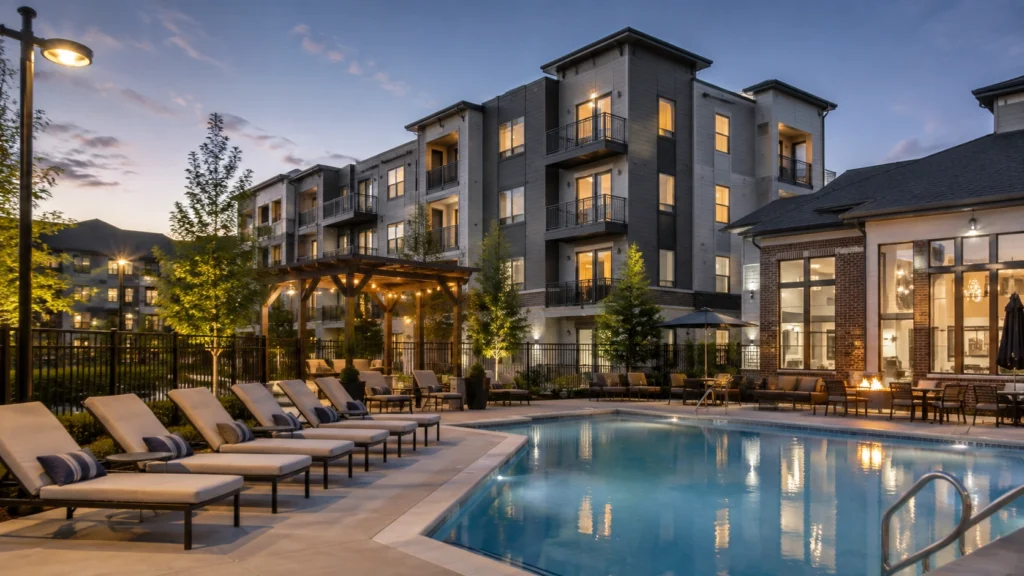
On our Tennessee acquisition, we underwrote conservatively, the way we always do. We built the plan around what we believed the property could reach by its second year. Three and a half months after taking ownership, the rents were already there. The property is stabilizing far ahead of schedule, and cash flow is running strong.
That is what conservative underwriting looks like when it is done right. Reality beats the plan instead of chasing it. When we set your expectations, we set them where we are confident we can land, not where we hope we might.
Better terms. More room.
Part of why we can underwrite conservatively & still hit our targets is that we start with better numbers than most operators our size. That comes from relationships, not luck.
Through our partner network, we qualify for Fannie Mae and Freddie Mac agency loans. On the Tennessee property, that meant a 5.65% rate. Those loans are hard to get and hard to qualify for. Once you are in, you can keep bringing that advantage to future deals. Lower borrowing cost means more cash flow, and that cash flow goes to our investors first.
Insurance is one of the largest operating costs in multifamily, and most brokers pull quotes from two or three carriers. The team we use went to forty carriers, worked weekends for two straight weeks, and brought back a rate roughly 20% below what everyone else pays. On a large property, that difference flows straight to returns.
We do not manage properties as amateurs learning on your money. We partner with professional management teams overseeing at least 20,000 units, teams with real policies, procedures, and experienced people. They bring institutional execution to properties we buy, so the value-add plan actually gets executed.
Our underwriting points us toward a specific kind of property. We look for value-add opportunities: solid buildings where something is being run wrong.
The rents are too low, the expenses are too high, the operation simply is not as sharp as it could be. That gap is where the return lives, and fixing it is work we know how to do.
We choose workforce housing in safe, low-crime areas, usually B and C class properties in A and B neighborhoods, at a hundred units or more so the economics work. If one unit in a hundred goes empty, we are still 99% occupied. That scale is its own kind of safety.
What we avoid is just as deliberate. We do not chase premium, fully stabilized buildings that already run perfectly and only return a few percent a year. There is nothing wrong with that approach, it is simply not ours. We buy the chance to make something better, not the privilege of paying top dollar for something already finished.
Past performance is not indicative of future results.
Underwriting decides whether we buy. Everything after that is execution, and it is a lot. Most investors never see it, which is exactly the point. When a deal closes at the title office, the visible part is done in an afternoon. The invisible part took weeks.
Before that closing, we have stood up professional property management, the lawyers have prepared the private placement memorandum and the operating agreement, and we have taken over and funded every service contract the property runs on. On a property of a hundred units or more, even the utility deposits are serious money. The electric deposit alone on a large property can run thirty thousand dollars, and that is handled before a single investor has to think about it.
This is what passive ownership actually means. The general partners do the work and put their own money in alongside yours. You own a share of a real, operating asset, and the operating is our job, not yours. You are not going to get a call about a broken system at two in the morning. That call comes to us.
The questions investors ask before anything else. Not seeing yours? Send it over no call required.
It means testing whether a property can keep performing when things go wrong: lower occupancy, higher expenses, higher taxes, or rising interest rates. We model each of those scenarios before buying. If the deal cannot survive them, we do not move forward.
We underwrite to a minimum 18% IRR and target a 2x to 3x equity multiple over a three to five year hold. If a deal cannot clear that bar, we pass on it.
It means setting expectations where we are confident we can land, not where we hope we might. On our Tennessee deal, rents reached our year two projections within the first 3.5 months, because we planned cautiously and the property outperformed the plan.
Through our partner relationships, we qualify for Fannie Mae and Freddie Mac agency loans that are difficult to access at our size. Lower borrowing costs mean stronger cash flow, which is paid to investors first.
Value-add workforce housing, typically B and C class properties in safe A and B neighborhoods, at 100+ units. We look for well located buildings that are underperforming and can be improved through better operation.
By the time an opportunity reaches you, it has already survived every hard question we know how to ask. That is the point of all of it: so that when we bring you a deal, you can trust that the discipline already happened.